I Build For The Rep,
Not The Deck.
Most positioning dies somewhere between the launch deck and the live call. I've spent 8+ years closing that gap: category narrative the executives sign off on, and the enablement systems that get 500 reps carrying it. CI/CD, software delivery, security.
Experience at


Brands worked with

How I Actually Use AI
Knowing which bucket a task belongs to matters more than knowing which tool to use.
Runs without me
A Python CLI I wrote on the Claude API, with web search built in, that generates full competitive intel reports on demand. It loops on searches, synthesizes the findings, and hands back a structured report ready for sales or positioning.
Manual research can't keep pace with AI launches; the landscape shifts mid-cycle. The CLI handles velocity, and I vet every report against analyst calls and win/loss data before it ships.
Scales my judgment across the team
A custom GPT I built and maintained for our sales team, loaded with current messaging, competitive battlecards, and objection-handling, refreshed on a bi-weekly cadence. Reps asked competitive questions in plain language and got answers grounded in live positioning.
I built it for leverage and that is what it returned: 75% rep adoption, with the field getting answers mid-deal instead of waiting on me.
Shipped what the process wouldn't
Our demo environment was weak and I couldn't fix it through official channels. So I used Claude Code to build my own: four industry-specific demo apps on our feature management product, each tailored to the pipeline patterns I found analyzing deals by vertical. The SE team adopted it for their own cycles.
In the early going we skipped two POVs entirely. Deal cycle time was one of my core PMM metrics, and this moved it directly.
The calls I keep human
Positioning decisions, what we're choosing to claim versus competitors, what an analyst told us off the record. AI doesn't touch any of it. Not because I'm nervous about the tool, but because those are the judgment calls I'm paid to make.
Tools in rotation
Perplexity
ChatGPT
Claude Code
Otter.AI
Whispr Flow
Gamma
The person behind
the positioning.
I work on B2B tech with long sales cycles, buying committees of six or more, and products that are genuinely hard to explain. My job is to make the explaining easier, and to hand sales a story they'll use without being told to.
I've done this across DevOps, CDN, infrastructure, and enterprise software and services. In all of them the product advantage was real and invisible until somebody put it into words a buyer recognized.
Outside work it's my wife and three young kids, plus a round of golf when I can sneak one in. Golf is mostly an exercise in accepting that you cannot control every variable, which turns out to be decent practice for this job.

Featured Work
Real problems, clear thinking, measurable results.
Positioning & Launch
Release Orchestration Narrative
CloudBees
Challenge
Fragmented product narrative left sales struggling to differentiate in a crowded DevOps market. Deals stalled at the value conversation.
Insight
Buyers didn't care about features. They cared about pipeline risk and deployment confidence. The product solved a real enterprise pain point, but the story wasn't connecting.
Action
Rebuilt positioning around release intelligence, built the core messaging framework, and drove narrative alignment across product, sales, and exec teams.
Impact
Drove +26% ARR on a $45M product line by reframing the story from Jenkins connector to enterprise release control plane, and aligned the CEO, CMO, and co-founders on the identity shift.
Analyst Relations
Gartner MQ / Forrester Wave Strategy
CloudBees
Challenge
Company was under-positioned in key analyst reports despite having a strong product. Narrative gaps were costing deals at the enterprise validation stage.
Insight
Analysts evaluate narrative as much as product capability. Internal teams weren't telling a coherent, differentiated story; every function had its own version of the truth.
Action
Led analyst relations strategy, reframed differentiation narrative, and coordinated cross-functional input for submissions and briefings.
Impact
Secured inclusion in both reports. The unified narrative laid the foundation for what became CloudBees Unify, a single platform story replacing a patchwork of disconnected products.
Partner Marketing
Partner Solution Launch
IBM / Akamai
Challenge
Joint solution had real technical value but lacked a market-facing story that either partner's sales team could articulate on their own.
Insight
Enterprise buyers needed to see the integrated value proposition, not two separate product pitches stapled together.
Action
Developed joint positioning, co-branded messaging architecture, and a launch playbook. Aligned stakeholders across two large, complex organizations.
Impact
Drove 20% YoY bookings growth, a partnership record, across a $125M+ alliance portfolio. Shipped the first integrated Zero Trust Network Access offering in the alliance's 20-year history, launched and presented at IBM Think 2020.
Partner Enablement
Channel Portfolio Strategy
Lenovo
Challenge
A 30-vendor software portfolio was going to market as 30 separate stories through a distributed partner channel. Partners wanted to sell it and had no way to know what to lead with, so most defaulted back to hardware.
Insight
The bottleneck was the absence of a point of view. Thirty vendors is a catalog, not a portfolio. Partners needed three things to sell, not thirty things to learn.
Action
Segmented the portfolio into three strategic pillars and established security as the primary growth lane, setting vendor priority across Absolute, SentinelOne, and Secret Double Octopus. Built the enablement layer to match: a job-to-be-done playbook mapping solutions to buyer roles, messaging templates, and co-sell assets built for self-service. Stood up the first centralized software presence on Lenovo Partner Hub, including the tiering mechanism that set partner status.
Impact
Gave the channel one prioritized story instead of a catalog, and a launch-readiness scorecard that replaced 'are we ready' negotiations with an owned checklist. On-time launch and the fastest channel activation in the portfolio.
AI Product Launch
AI Platform GTM: Unify AI
CloudBees
Challenge
Three AI products (AI Assistant, First Responder, Unify AI) were going to market as three separate launches, into a DevOps audience that had already tuned out vague AI claims. We were also arriving at GA six to nine months after competitors were embedded in enterprise deal cycles.
Insight
Marketing the AI features individually was the actual problem. Every release read as one more disconnected capability, which is how buyers decide a vendor is chasing a trend. One umbrella narrative, with each product entering as proof of it, was worth more than three announcements. And buyers didn't want an AI story at all: they wanted proof we solved incident chaos, slow triage, and alert fatigue. Lead with the problem, let the AI be the mechanism.
Action
Collapsed the three launches under a single Unify AI narrative, with product-specific messaging grounded in operational outcomes underneath it. Changed the launch trigger from GA to demoable, moving the anchor to a recorded demo and recovering 90 days against competitors. Built agentic AI demo environments in Claude Code so field teams had something to put on the screen.
Impact
Moved CloudBees from a CI/CD tool to a platform conversation at the VP Engineering and CISO level, and positioned First Responder as an integrated alternative to standalone incident management. Measured on Stage 1-3 pipeline velocity and field adoption of the new messaging rather than launch-day noise.
Revenue Growth
Cloud Services GTM: Microsoft CSP
Lenovo
Challenge
Customers could buy M365 directly from Microsoft, and many did. The opportunity was shifting that motion to Lenovo, where cloud licenses became the entry point for layering on Managed Services and creating low-friction expansion.
Insight
The win pattern was already sitting in the data: particular account profiles, deal stages, and triggers that reliably preceded a CSP upsell. Reps weren't unwilling, they just had no way to tell which accounts were worth the call.
Action
Built win intelligence and automated lead scoring to surface the right accounts. Created messaging that framed Microsoft cloud as margin expansion, not a product add-on. Unlocked MDF investment to fund the outreach motion.
Impact
+272% YoY revenue growth on Microsoft cloud services.
What Colleagues Say
Recommendations from LinkedIn.
Drew drove 20% YoY bookings growth (a record) on a nine-figure channel business and was nominated to speak at IBM Think while at Kyndryl (formerly IBM GTS). I led Akamai's IBM partner enablement strategy while Drew managed Kyndryl's go-to-market strategy and enablement delivery. In a field full of people who talk about results, Drew went deep on Akamai's cloud security and performance technology and turned it into something sellers could actually use. That translation work, taking a genuinely complex product and making the business value obvious, is the hardest part of this job and the part he is best at.
What makes Drew different is how he works. Hand him a simple set of objectives and he returns a multi-step plan to deliver, plus the tools and techniques to pivot as the campaign starts generating feedback. He worked across Product, Sales, and Field Marketing on both sides of the partnership and made those teams better together, and he put status updates in my inbox before I asked. His high expectations of himself mean you can count on him to learn whatever he needs and turn results around fast. That tenacity is what carried a complex technical integration across our partnership from justification to launch.
His career since we worked together shows the same pattern: challenge, success, growth, new challenge. I learned a great deal about my own craft working alongside him, and I will always recommend Drew Piland for roles where execution and communication are essential.
Dan Schaffer
Director of Strategic Partnerships and Programs
Akamai
Worked with Drew across companies (Akamai and Kyndryl, formerly IBM GTS)
Drew is equal parts strategic thinker and expert doer. We worked closely together at CloudBees, where I worked on the brand side and he worked on the product marketing side. Drew was a go-to subject matter expert for the broader marketing team, and I personally loved pressure-testing messaging ideas with him because of how deeply he understood the technology, the market, and our audience. He was very effective at translating that depth of knowledge into clear, accessible language.
As one of the longer-tenured employees at CloudBees, Drew had seen the company and its product portfolio through many changes and pivots. Through it all, he remained adaptable, positive, collaborative, and focused on what would create the greatest impact for customers.
Beyond his expertise, Drew is simply a kind, thoughtful colleague who is incredibly easy to work with. Any team would be lucky to have him.
Anna Tannas
Brand Strategist | Creative Operations Leader
Strategy, Systems, & Storytelling
Senior to Drew at CloudBees, didn't manage directly
Drew is what I call a proactive thinker, builder, and operator. He's incredibly easy to work with because he takes the initiative to address issues well before they become problems. Drew has a knack for connecting people across functions, building alignment, and delivering work that addresses the company's most pressing needs. Whether he's solving an immediate challenge or building a new capability from the ground up, he brings strong ownership and sound judgment. I highly recommend him!
Bryan Elanko
Technical PMM Leader | PMA Ambassador
ex-Shopify
Worked together on the same team
Talks & Thought Leadership
On stage and on camera, translating complex topics for technical and business audiences.
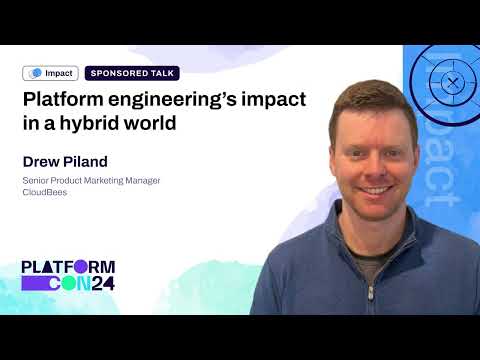
Platform Engineering: Market Dynamics, DevOps Integration & Build vs. Buy
Walked through the market forces shaping platform engineering, its strategic role in modern DevOps, and a framework for navigating the build vs. buy decision in enterprise organizations.
Watch Recording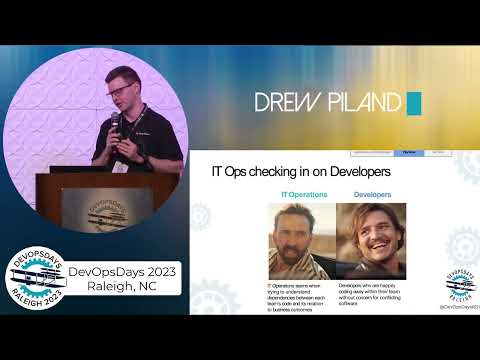
Release Orchestration: Bridging the DevOps SDLC
An Ignite-format talk: 5 minutes, 20 slides, auto-advance every 15 seconds. Covered Release Orchestration as a capability: what it enables for engineering organizations and how it bridges the gaps in the software delivery lifecycle.
Watch Recording
The Release Gap: Why CI/CD Isn't Enough
The "release gap" is my term for the distance between continuous delivery and production confidence, and the argument that more CI/CD never closes it. I developed the concept and the original research behind it, and it became the anchor for CloudBees pipeline intelligence positioning.
Download eBookClaude Code: Live Platform Demo
Shared a live walkthrough of Claude Code (Anthropic's AI coding platform), demonstrating real-world workflows. The post reached the developer tools and AI community on LinkedIn.
View Post
Agentic AI in DevOps: Exploring Use Cases for the CloudBees MCP
Explored how agentic AI and the Model Context Protocol (MCP) are reshaping DevOps workflows, from automated pipeline management to intelligent release decisions. Written to position CloudBees at the frontier of AI-native DevOps.
Read Post
Putting Cloud Native in Perspective
A strategic guide for enterprise teams navigating the shift to cloud native, covering containers, microservices, and the organizational realities that determine whether the transition succeeds.
Download eBookWhat I Do
Four disciplines. Most of the work pulls on all four at once.
Positioning & Messaging
Working out what a product should stand for, who it is for, and why anyone would switch. Category framing at the top, the competitive one-liner a rep uses on a call at the bottom.
- Buyer persona and jobs-to-be-done research
- Competitive positioning and battlecard development
- Core messaging frameworks and value proposition architecture
Launch Strategy
Getting product, sales, and marketing pointed at the same date with the same story. I run a launch as a program that lasts a quarter, and I keep measuring it well past launch day.
- Cross-functional GTM planning and launch playbooks
- Tiered launch frameworks scaled by market impact
- Post-launch measurement and iteration cadence
Sales Enablement
The story, the tools, and enough rehearsal that reps trust it in front of a buyer. I judge this work by one thing: whether reps reach for it when nobody is watching.
- Pitch decks, battlecards, and objection-handling guides
- Buyer-stage content mapped to the sales funnel
- Sales training and messaging adoption programs
Executive Narrative
Board decks, analyst briefings, exec narratives. Turning what is happening in the market into a version a busy executive can make a decision on.
- Gartner MQ and Forrester Wave preparation
- Board and C-suite presentation strategy
- Market category and thought leadership narrative
Tell me about the
positioning problem.
I'm targeting Principal and Director Product Marketing roles: category-defining products, technical buyers, and a field that needs more than a deck. If you're deciding what your product should stand for, or why the story isn't landing in deals, that's the conversation I want.